
The New War: Warframe's Epic Expansion That Reshaped the Origin System
The New War expansion stands as one of the most ambitious narrative undertakings in Warframe's long history, a turning point that redefined how players experience the game's sprawling universe. When it first launched across all platforms back in December 2021, it wasn't merely another update—it was the culmination of a story arc that had been simmering for years, a crescendo of tension between the Tenno and the Sentients. Even in 2026, players look back on this cinematic quest as the moment Warframe transformed from a loot-driven looter-shooter into a genuine interactive space opera, where the fragile alliances of the Origin System were tested in a five-hour campaign of fire and desperation.
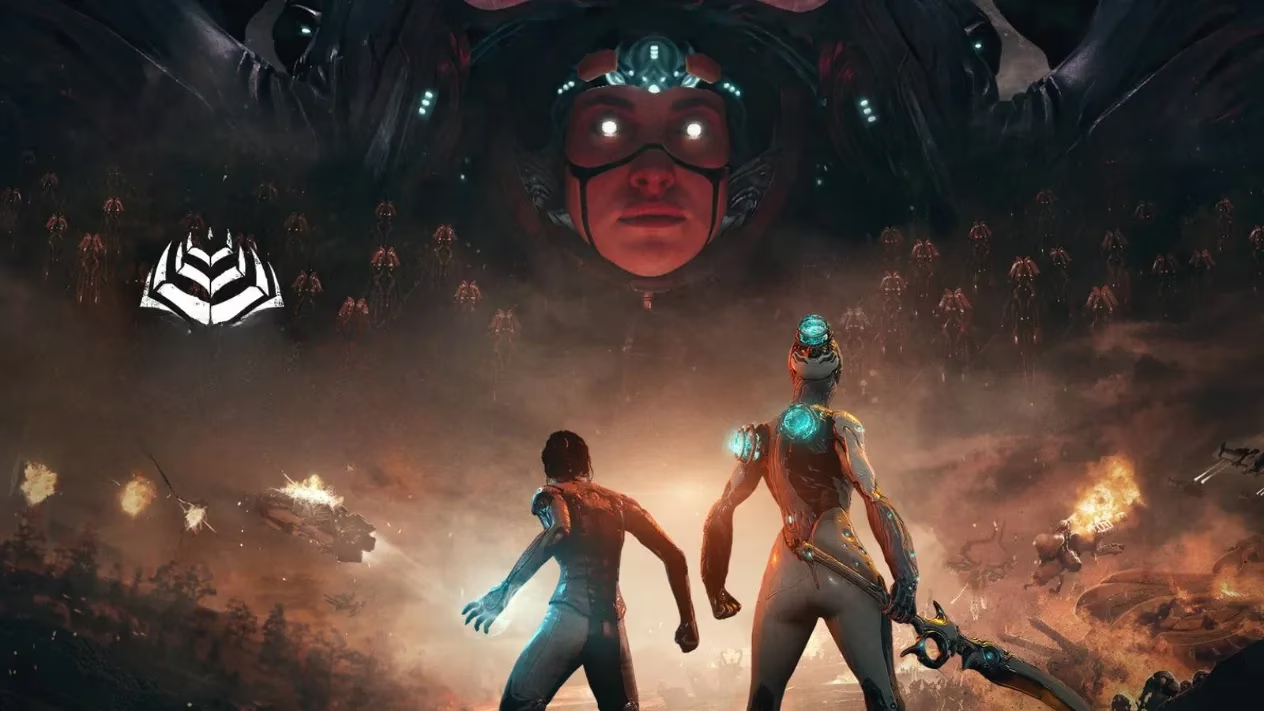
The expansion unfolds like a triptych painted by a mad artist, splitting its narrative into three distinct acts, each viewed through the eyes of a temporary protagonist far removed from the god-like Tenno. This structural choice was a gamble, like handing a Stradivarius to three different musicians in the middle of a symphony, yet it paid off by injecting raw vulnerability into a power fantasy. First comes Kahl-175, a Grineer clone soldier whose existence is a whisper in the machinery of an empire. Stationed on the Plains of Eidolon, his world erupts when Sentient dropships darken the sky. Kahl, lacking transference or Void magic, clings to survival the way a candle flame flickers against a hurricane—his resolve propped up only by his rudimentary firearms, his armored fists, and the dying shouts of his fellow clones. Through his eyes, the invasion isn't a strategic challenge but a desperate, visceral scramble for one more breath.
Then the perspective shifts to Veso, a Corpus technician trapped aboard a vessel overrun by Sentient boarders. Where Kahl embodies brute simplicity, Veso is a spider repairing its web mid-collapse, using turrets, shield drones, and the cold logic of profit-driven technology to stall the inevitable. His segment underscores a poignant truth: the Corpus, for all their greed, are still flesh and blood, capable of ingenuity and terror when cornered. The final act belongs to Teshin-Dax, an ancient warrior whose voice has echoed through the game like a bell from a forgotten era. A survivor of the Old War, Teshin steps forward not as an instructor but as a comrade, his twin blades dancing in a last stand that feels both tragic and inevitable. His perspective blends the melancholy of a relic with the fierce pride of a samurai, and his sections remind players that some bonds, no matter how thin, can hold back the tide.
Accompanying this narrative upheaval was the arrival of Caliban, the 48th Warframe, a being forged from the very essence of the Sentient menace. Caliban’s abilities—summoning conculysts, unleashing devastating fusion strikes—turned the tools of the enemy against them, and his design served as a grotesque trophy of the war itself. Simultaneously, Harrow Prime Access brought the gun-wielding priest into the Prime pantheon, his enhanced stats and gilded aesthetic offering a sacred firepower for those who wished to smite their foes with divine precision. These additions weren't just carrots on a stick; they were thematic extensions of a universe at war, where even the holy and the alien blurred into something new.
To even step foot into The New War, Tenno had to meet steep prerequisites: every mainline quest leading up to it completed, a Railjack ready in their dry dock, a Necramech stomping in their arsenal, and an Archwing for the skies. This gauntlet of preparation was less a barrier and more a rite of passage, ensuring that those who entered truly understood the weight of the conflict. By 2026, these requirements are almost nostalgic, a testament to how integrated these systems have become in the daily life of a Tenno, but back then they cemented the expansion as a reward for the most dedicated.
The New War was more than a flashpoint; it served as the genesis for the narrative threads that would later weave into the Duviri Paradox and beyond. Its three-actor structure proved that Digital Extremes could paint a universe from the bottom up, not just the top down, and it set a standard for storytelling that the community still dissects in forums and podcasts years later. The flames that engulfed Cetus and the capture of figures like Konzu were not just set pieces but embers that sparked countless theories and cemented the Sentients as far more than just another faction. Like a key turning in an ancient lock, The New War opened doors to a future where every NPC could be a hero, and every moment could carry the weight of an entire system’s survival.
Comments